

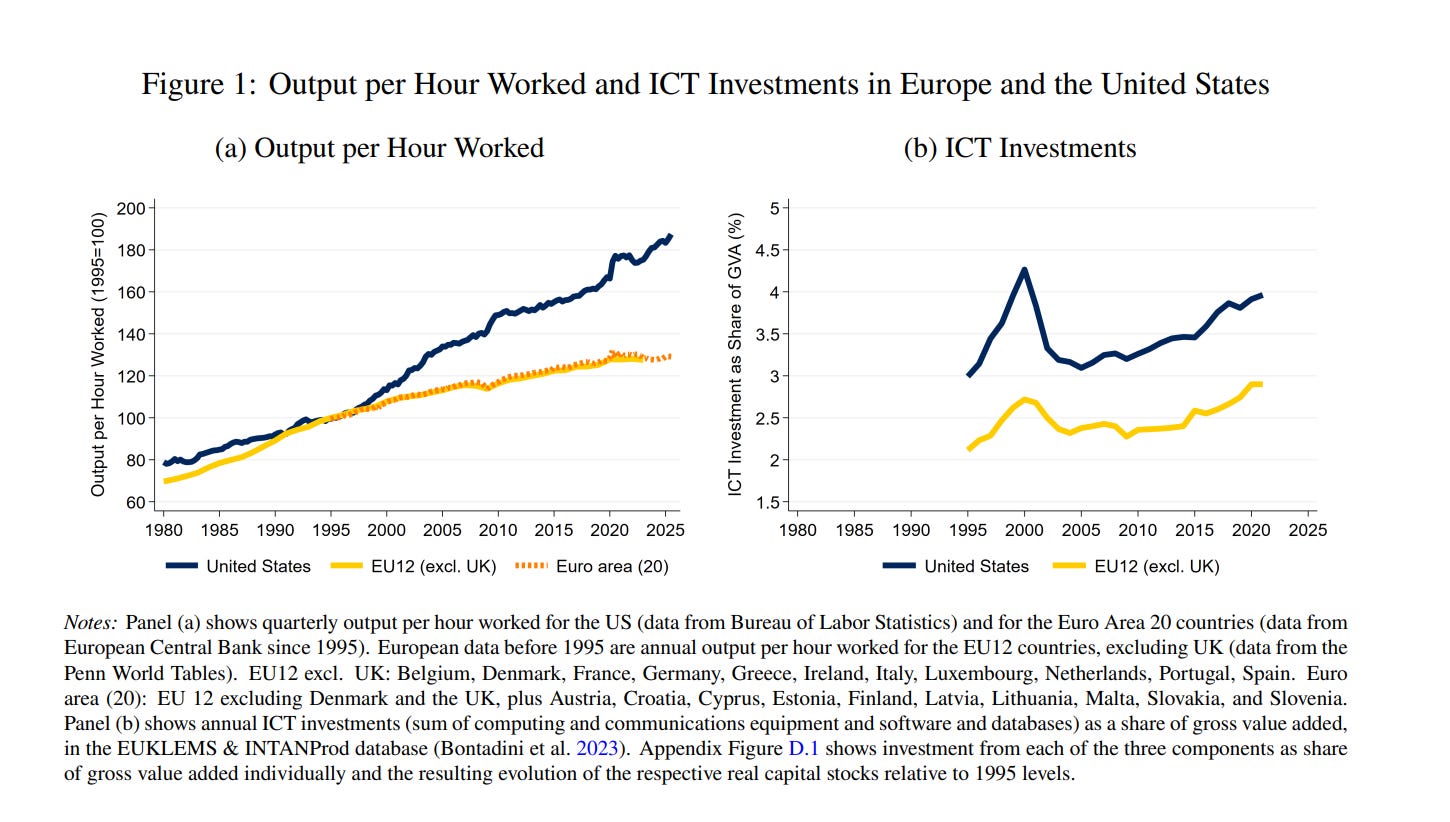
Between 1995 and 2025, output per hour rose 85 percent in the United States and 29 percent in the countries in the eurozone. Previous research has found that the differential impact of the information technology revolution is the likeliest explanation. A forthcoming Brookings paper by Alexander Bick, Adam Blandin, David Deming, Nicola Fuchs-Schündeln, and Jonas Jessen, asks whether artificial intelligence is opening a similar gap. The answer, with some caveats, is yes.
In a worker survey that the authors undertook in the US and six European countries (Germany, the UK, France, Italy, Sweden, and the Netherlands) they found that, in early 2026, 43 percent of US workers were using generative AI for their jobs, compared with 32 percent on average in the six European countries. The UK leads the surveyed European countries at 36 percent. France and Italy trail at 28 percent and 26 percent.
The gap in how intensely workers use the tools is even larger: 5.2 percent of total US work hours involve AI, roughly double the rate in Northern Europe and triple that of Germany, France, and Italy. These are self-reported figures for conscious use of generative AI and the authors argue they should be read as lower bounds on actual adoption, as AI could be used in the background, without workers’ awareness, as well. They also report firm level comparisons, but they caution that it is less clean, since the US and EU surveys differ in question framing, reference period, and coverage. On the most comparable measure, AI use in the production of goods or services, 7 percent of US firms report adoption versus 4 percent for the EU average.
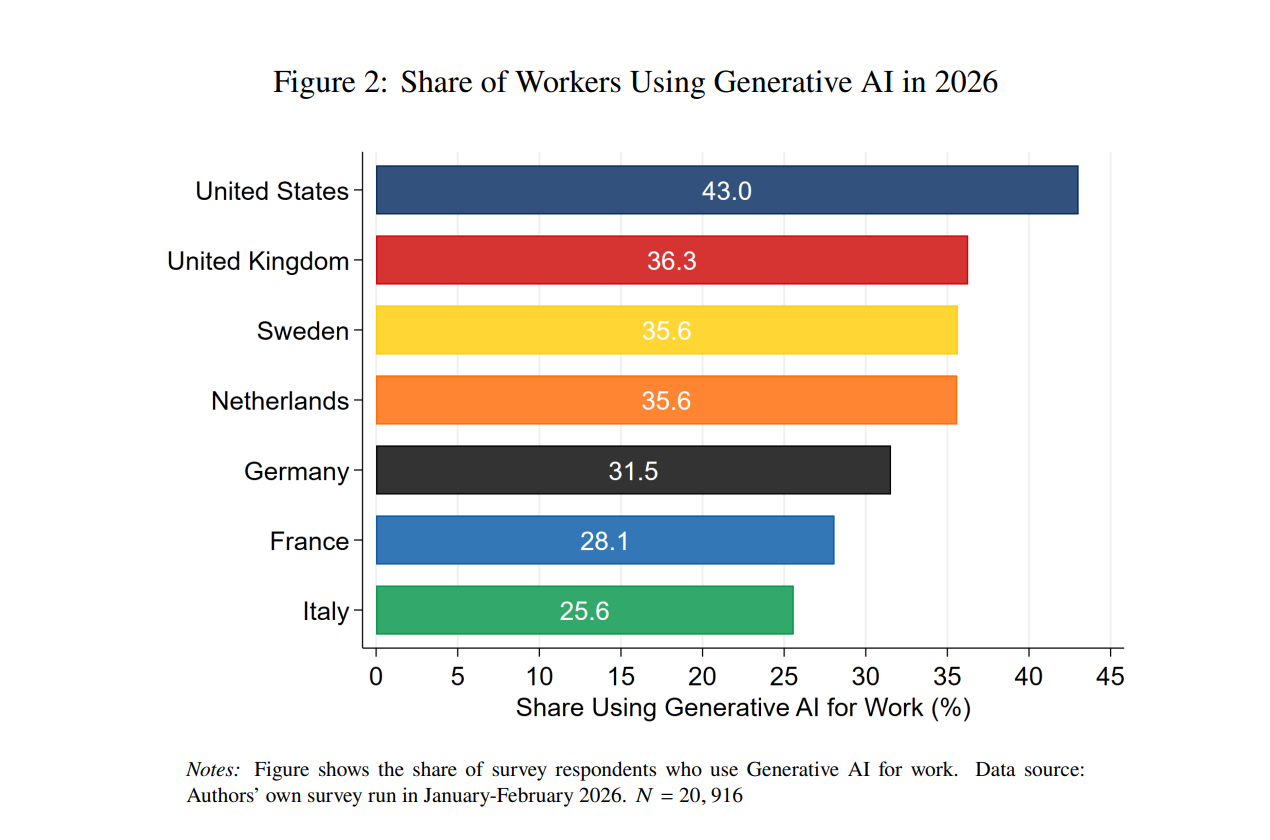
But what jumps out at me from this picture, more than the US gap is the within-Europe gap, which repeats the gaps we saw in the adoption of ICT. Britain, Sweden and the Netherlands beat Germany, which beats France and Italy. What drives these gaps? Part of it reflects compositional differences in education, occupations, industries, and firm size. A statistical decomposition of the effect across the six surveyed countries finds that demographics, occupation, industry, and firm size explains 55 percent of the average gap. But roughly half remains unexplained by those factors.
Management matters
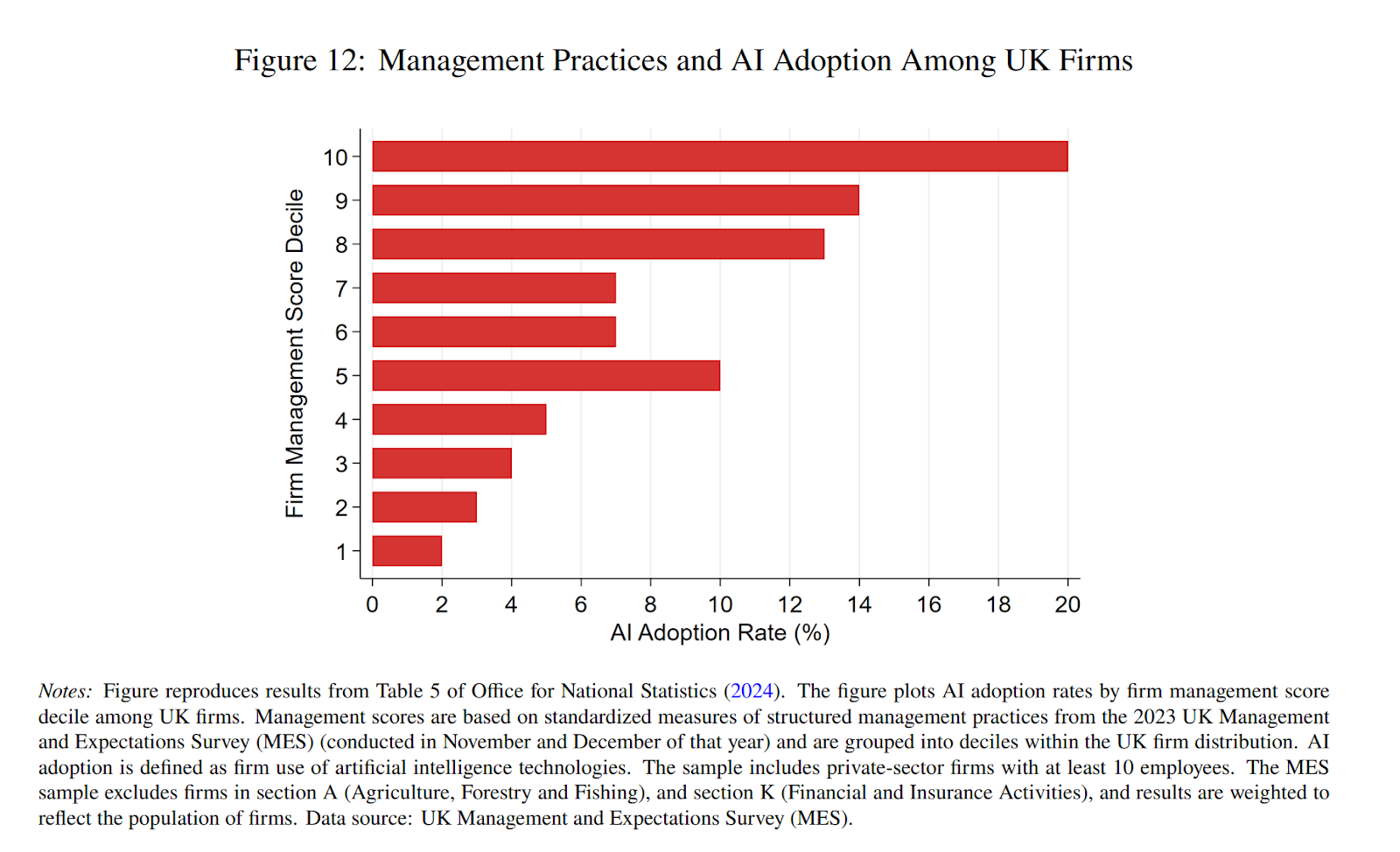
The paper’s most novel claim is that management accounts for much of that residual. World Management Survey scores, which measure management practices in an homogenous way across countries, are highly correlated with AI adoption rates not just between countries (correlation: 0.81), but also within countries. Within the UK, only 2 percent of firms in the bottom management decile adopt AI, versus 20 percent in the top decile. Using their own worker surveys, the authors construct a personnel management index, based on whether firms reward performance, promote on merit, and address underperformance. A one standard deviation increase in this index is associated with 9.6 percentage points more AI adoption, controlling for country, demographics, industry, and firm size.
This is not the first time that the same technology, available at similar prices, has been adopted at very different rates. The ICT revolution followed an identical pattern. Nick Bloom, Raffaella Sadun, and John Van Reenen showed in 2012 that US firms invested more in ICT and got higher returns from it, and that differences in management practices explained a majority of this advantage.
To understand how and why management matters, it helps to drill down on one case study. The new paper by Bick et al (2026) cites a study I did with Paul Heaton, in which we analyzed how management affects the adoption and use of information technologies by police departments, by using data from nearly all US police departments between 1987 and 2003 to measure adoption and its effects on crime.
American police departments spent heavily on computers during the 1990s and 2000s.
We found that the productivity gains appeared only when technology was combined with deep organizational change. The model that worked was CompStat, the management system pioneered by Bill Bratton in the New York Police Department. If you have seen The Wire, you know how Compstat works: crimes get geocoded, the precinct commanders are trained on the system and made accountable for what their cops are doing and where they are deployed. We found departments that adopted IT with the full CompStat bundle saw crime clearance rates increase by 3.2 percentage points, while those that did not adopt the bundle did not experience an improvement, even if they purchased the computers and software.

NYPD Compstat meeting. NBC News
Peter Moskos, a sociologist who also served as a patrolman in Baltimore, recounts in a recent book how the credit for CompStat belongs to a cop named Jack Maple. Maple was a working-class transit lieutenant from Queens, who wrote an unsolicited memo to Bill Bratton, the NYC police commissioner, advocating the use of geocoded data to solve crime. Bratton read it and later pulled him up through the ranks to be the manager in charge of design, deployment and implementation of the CompStat system. He later called Maple the smartest cop he ever met.

Richard Corkery/NY Daily News Archive
Maple was obsessed with geolocating crime. Before the digital tools existed, he had covered 55 feet of wall with maps of the transit system and tracked crimes and clearances with crayons, by hand, in what he called the “Charts of the Future.” With Bratton backing him, he used the data to hold commanders accountable. The CompStat meeting became what Bratton called “the grand theater where precinct commanders are called to account,” sometimes “browbeaten” in front of their peers.
Maple’s lesson spread unevenly through the US: departments that bought the same computers but did not change their management saw no improvement. The technology was necessary, but it was reorganization that made it productive.
Why Europe has fewer Maples
Apart from providing an overall score, the World Management Survey run by Bloom, Sadun, and Van Reenen has been analyzing the frequency of specific management practices across countries for two decades i Their findings provide a possible explanation for why the Bick et al. results look the way they do.
American firms score higher on average on management practices than European firms. The gap is significant, and it persists even when you compare firms of the same size, in the same industry. Three forces drive it. First, competition: US product markets are more contestable, and badly managed firms die faster, which raises the average. Second, ownership: a larger share of European firms, especially in Southern Europe, are family-managed (as opposed to family-owned but professionally managed), and family management is strongly associated with lower management scores. Third, labor regulation: rigid employment protection makes it harder to reward high performers and address low performers, which is precisely the personnel management index that predicts AI adoption in the Bick et al. data.
Italy is the extreme case. Bruno Pellegrino and Luigi Zingales (2017) linked bad management practices to slow IT adoption and argued this failure is the main reason Italy’s productivity has stagnated:
We find that Italy’s productivity disease was most likely caused by the inability of Italian firms to take full advantage of the ICT revolution. While many institutional features can account for this failure, a prominent one is the lack of meritocracy in the selection and rewarding of managers. Unfortunately, we also find that the prevalence of loyalty-based management in Italy is not simply the result of a failure to adjust, but an optimal response to the Italian institutional environment. Italy’s case suggests that familism and cronyism can be serious impediments to economic development even for a highly industrialized nation.
In Pellegrino and Zingales‘ view, management practices respond to an institutional environment where weak contract enforcement and dense networks of personal relationships made loyalty-based management rational for individual firms, even as it proved disastrous for aggregate productivity. Familism and cronyism, they concluded, can be serious impediments to economic development even for a highly industrialized nation.
The Bick et al. paper today points to the same past pattern repeating with AI. Italy has the lowest worker AI adoption rate among the six countries surveyed (26 percent), the lowest share of firms encouraging AI use, and the lowest share providing AI tools. The authors argue that management practices that blocked ICT diffusion are blocking AI diffusion. The technology changed, but the institutional environment that made IT adoption fail is placing the same obstacles to the adoption of artificial intelligence.
The organizational gap
Technology adoption is often not a technological problem, but an organizational problem. The gains from a new technology go to firms and institutions that reorganize around it. But doing so requires decentralizing authority, holding people accountable for results, and actively pushing workers to experiment. Firms that buy the technology but do not change how they work see little benefit.
While the Bick et al. paper cannot prove this story causally, the pattern is consistent across methods, geographies, and decades. Much of the heterogeneity in artificial intelligence adoption is not just within the EU, but within European countries, and much of it traces back to how firms are managed. This will be much harder to solve than repealing the AI Act or GDPR: it points to deep institutional failures in many countries, especially in the European periphery.
References:
Alexander Bick, Adam Blandin, David J. Deming, Nicola Fuchs-Schündeln, and Jonas Jessen, “Mind the Gap: AI Adoption in Europe and the U.S.,” NBER Working Paper 34995, March 2026. Forthcoming in the Spring 2026 Brookings Papers on Economic Activity.
Bloom, Nicholas, Raffaella Sadun, and John Van Reenen. "Americans do IT better: US multinationals and the productivity miracle." American Economic Review 102, no. 1 (2012): 167-201.
Garicano, Luis, and Paul Heaton. “Information technology, organization, and productivity in the public sector: Evidence from police departments.” Journal of Labor Economics 28, no. 1 (2010): 167-201.
Moskos, Peter. Back from the Brink: Inside the NYPD and New York City’s Extraordinary 1990s Crime Drop. Oxford University Press, 2025.
Pellegrino, Bruno, and Luigi Zingales.”Diagnosing the Italian disease” NBER working paper No. 23964. National Bureau of Economic Research, 2017.
Had no idea about Jack Maple covering 55 feet of wall with hand-drawn crime maps before digital tools even existed. That's incredible. And the fact that departments buying the same computers without changing management saw zero improvement. Technology adoption really is an organizational problem, not a technological one.Fascinating piece.
I wonder how much is culture? Europeans simply value "productivity" less and so its harder to get buy in. Any surveys on that?