

This post is co-authored with Jesús Saa-Requejo1
The hundreds of billions that European governments spend on defense, health, education, and public administration barely touch AI. Directed well, this spending, which accounts for up to half of European GDP, would improve the efficiency of Europe's sclerotic public sector. But it could also create the conditions for the appearance of a layer of firms doing the messy work of turning general-purpose AI into sector-specific products, which Europe currently lacks and badly needs.
In Part I of this essay, published last July, we argued that the EU should stop focusing its strategic efforts on chasing the frontier in foundational AI and instead focus on becoming a fast and smart adopter. Our argument was based on the conjecture that intelligence is on its way to becoming a commodity.2 The plummeting costs per token, the constant change of the leading model between the three top AI labs (OpenAI, Anthropic and DeepMind), and the existence of an open-weights ecosystem, running a few months behind the frontier, still suggest that this may be the path. In a world where intelligence becomes cheap and widely available, value accrues not to model builders but to firms that integrate AI most effectively. Our conclusion was that the European Union’s job was to deregulate AI adoption, force open standards, build data commons, and let its world-class industries do the rest.
We believe that our diagnosis was correct. However, our prescription was incomplete. We identified implementation and diffusion as the correct layer, but assumed that companies would emerge to exploit it if the European Union cleared the regulatory excesses and kept foundation models competitive. The European open standards and interoperability rules we proposed remain necessary. Without them, European users become captive to a few American gatekeepers. But they are not sufficient. Europe needs a mechanism to get the missing implementation layer started.
We propose here using Europe's public procurement power and a redesigned digital tax to seed this layer, relying on joint ventures pairing foreign AI companies with European partners. Does this kind of forced partnership work? China's auto industry is widely seen as a useful precedent.
Turning failure into success
Under the 1994 Automobile Industry Policy any foreign automaker manufacturing in China had to partner with a Chinese firm, with foreign equity capped at 50%. Import duties that had reached up to 260% in the mid-1980s, and remained prohibitively high through the 1990s, made local production the only way into the market. VW, GM, Toyota, and Peugeot complied.
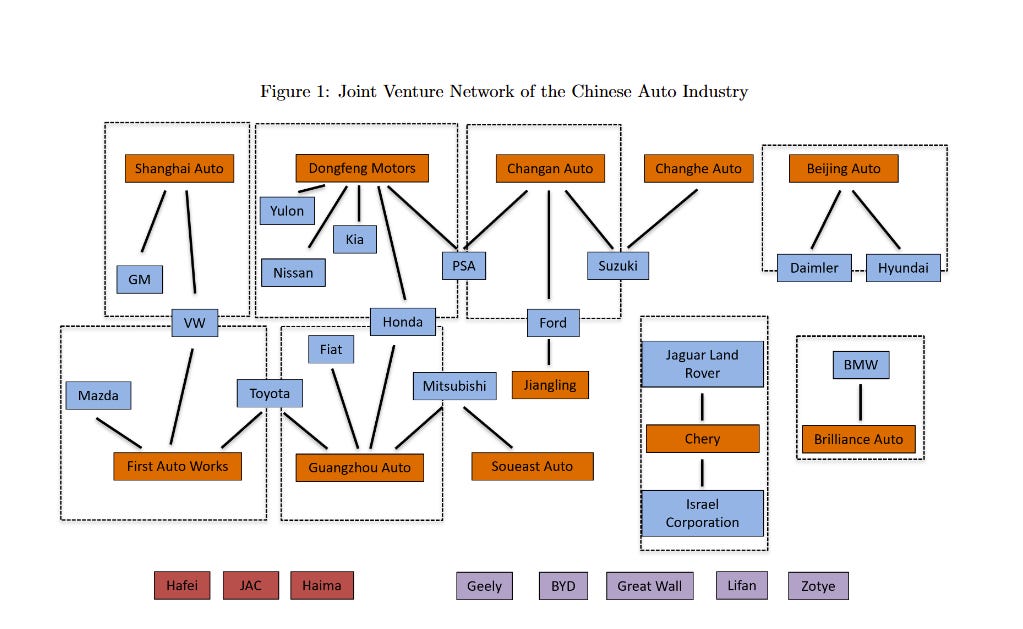
The policy’s objective was to transfer internal combustion engine technology to Chinese state-owned enterprises. In this sense, it failed. The foreign partners transferred the outcome of their technological capability (the vehicle blueprints) but not the capability itself (the engineering capacity to design the cars). The immense profitability of just producing and selling VW and GM vehicles turned SOEs like SAIC, FAW, and Dongfeng into rent-collectors. The joint venture strategy was widely considered a failure given the inability of Chinese carmakers to stand on their feet. He Guangyuan, industry minister when the policy was approved in 1994, was sharply critical of its results in September 2012:
It's like opium. Once you've had it you will get addicted forever…From central authorities to local governments, everyone has been trying hard to bring in foreign investment. But so many years have passed and we don’t even have a one brand that can be competitive in the auto world…I feel red-faced.
Yet the joint ventures worked as incubators for supply chains and talent. J.D. Power quality data shows that in 2001, domestic models had 65% more malfunctions than joint venture models; by 2014, only 33% more. An excellent paper by Bai et al. (2025) identifies two channels. Workers who changed jobs moved from joint ventures to affiliated domestic firms, carrying production knowledge. Suppliers who built to global joint venture standards then sold the same high-quality parts to independent Chinese companies, producing firms like CATL in batteries and Yanfeng in interiors.
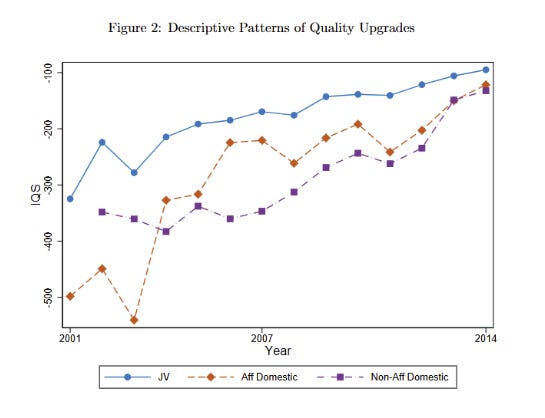
When the paradigm shifted to electric vehicles, the existing joint ventures, as well as their Chinese SOE parents, lost huge market share in 2024/2025. The companies that succeeded were all independent domestic brands rather than joint ventures offspring: BYD, Geely, NIO. But they could not have existed without the supply chain the joint venture policy generated.
The lesson for AI joint ventures is that the way the transfer takes place matters. In China's auto joint ventures, the foreign partner could hand over blueprints without handing over the ability to design cars. In AI the organizational capability is how to clean and structure data, how to redesign the way work is done. This kind of knowledge is hard to withhold. An American AI company that creates a joint venture to build, say, an AI-powered clinical decision support system for European hospitals with European engineers cannot keep them in the dark. They learn by doing.
The SOE failure, teaches the usual lesson: incentives matter. The Chinese partners were the result of state patronage, content to collect fees. The European partners of the AI diffusion companies must have skin in the game, and must face the discipline of a competitive market. The goal is not to create national champions sheltered from competition, but to seed an initial firms that can eventually stand on their own.
The Ukrainian market for drones
Public procurement is the second important lever that European governments have. Here, we think they should look to Ukraine for a model.
Before Russia’s full-scale invasion in 2022, Ukraine had seven drone manufacturers. By 2025 it had over 500, producing four million units a year. The industry now attracts over $100 million a year in private investment.
The architecture that made this possible has three features worth studying. First, the government acted as a committed buyer. The Ministry of Defense allocated over $2.5 billion to Ukrainian drone manufacturers in 2024-2025, and 96% of state FPV drone purchases went to domestic producers. Second, procurement was decentralized. Military unit commanders could order directly from certified manufacturers through the Brave1 marketplace or even directly from manufacturers, choosing which systems to buy based on what worked. Third, the entry barriers were kept low. Brave1 provided over 540 grants totalling $50 million, letting small teams prototype and test systems without the overhead of a traditional defense contractor.
As drone warfare is shifting from remote-controlled flight to autonomous navigation and machine vision, the firms that mastered hardware integration are moving naturally into software. AI-guided drones with autonomous target recognition are currently deployed at the front, and drone swarm software attracted the largest single investment in Ukrainian defense technology.
Of course, there is a huge obstacle to generalizing these lessons: war. An existential threat eliminates bureaucratic resistance; the front provides the best real life testing environment, and good incentives for the buyers, since you will not use your dollars to buy the dodgy drone if your life and security depends on the quality of your hardware.
But some lessons do transfer in our view to the AI implementation problem: the state set the demand floor, kept standards open, decentralized purchasing decisions to the users who knew what they needed, and refused to shelter incumbents. Europe’s proposed AI procurement programs in health, education, defense and public administration could adopt the same architecture: unified standards at the EU level, purchasing authority devolved to army units, hospitals, schools, and tax offices that will actually use the tools, and competitive entry open to any firm that meets the specification. The feedback loop will be slower than a battlefield, but it will be faster than a centralized procurement agency in Brussels or Athens deciding what software a clinic in Thessaloniki needs.
Sticks and carrots
For this approach to work, Europe needs both a stick and a carrot.
The stick is a European Digital Tax on large digital services companies. But what we propose is a special kind of tax. Companies subject to the tax could discharge part of their obligation not in cash, but by capitalizing joint ventures with European partners to create European AI diffusion companies. This aligns incentives. A digital company that pays its tax by investing in a JV has a financial interest in making that JV succeed. Its equity stake is worth more if the European partner becomes a competitive firm. Since many of the large digital services companies are also behind the frontier foundational AI models, they will be investing in their own customers. When every major AI company is scrambling to find revenue a guaranteed European channel should be attractive.
Some firms will prefer to pay the tax in cash. That is fine; the revenue still funds public AI procurement.
The carrot is public demand. The EU creates standardized specifications and interoperability requirements for AI-powered tools in four areas where public sector control is strong: defense, health, education; and tax compliance and social security administration.
Three conditions would apply. First, the tools must be built on open interfaces: standardized data formats, portable configurations, and documented APIs, so that any institution can switch providers without rebuilding its systems. Where open-weights foundation models are available and competitive, they should be preferred. But the non-negotiable requirement is substitutability, not open source. A hospital that adopts an AI diagnostic tool must be able to replace it with a competitor’s tool without losing its data or retraining its staff. In practice, this means the software is built so that the underlying AI model can be swapped out the way you change a light bulb: the rest of the system stays the same, only the intelligence behind it changes.3 If a better or cheaper model appears, the hospital switches in a day.
Second, the joint ventures receiving public contracts must demonstrate European capability transfer, by specifically hiring, training and retaining Europe-based engineers. Third, procurement decisions must be decentralized.
Is this industrial policy? Of course. The question, as always, is whether the conditions are right for success. Here, unlike in the car tariff case Luis analysed in an earlier post, the conditions we discussed then are better. These are public contracts, so these decisions belong in the public sector in any case. Moreover, there are no entrenched incumbents to protect, as this AI diffusion layer barely exists in Europe. Finally, the objective is clear: build implementation capability. The risk is the usual one: that the joint ventures specialize in collecting rents rather than in building capabilities. But doing nothing means Europe will import expensive AI services while its data and domain knowledge flow to the firms providing them. The competitive advantage of our industry will follow the data out of Europe.
References:
Bai, Jie, Panle Jia Barwick, Shengmao Cao, and Shanjun Li. “Quid pro quo, knowledge spillovers, and industrial quality upgrading: Evidence from the Chinese auto industry.” American Economic Review 115, no. 11 (2025): 3825-3852.
Jesus Saa-Requejo is chairman of Fondation L’Ontano and Board member at Vega Asset Management Holdings Ltd.
If instead a single firm achieves artificial general intelligence, and AI results in a concentrated industry structure, all of this changes. But then, all other bets (on every domain) are off.
Technically, this requires that AI-powered tools communicate with foundation models through a standardized interface (an API). If every provider uses the same format for requests and responses, switching models is straightforward. This is the software equivalent of a universal socket in which any plug fits.
We’re seeing this play out, the winners aren’t always the ones building from zero, they’re the ones who move fastest once the path is visible.
The real risk is not being second, it’s being slow at applying what’s already proven.
If worker mobility is the main channel then we know that the public has not the same mobility as the private. So you are losing most of your transmission mechanism. Also it is depressing that in the EU we would have to start from the public sector and not the private. Also you would need government to want to touch public bureaucracy for unbounded efficiency, something that I am not sure of