

We can build back greener, without so much as a hair shirt in sight. ... [We can] fly guilt-free, and our homes will be heated by cheap reliable power... And everywhere you look... there will be jobs. Good jobs, green jobs, well-paid jobs, leveling up our country while squashing down our carbon emissions.
Boris Johnson, 19.10.2021.1
Adam Brzezinski and I analyzed in a new paper tens of thousands of speeches from the 9th European Parliament (2019-2024) to understand how politicians talk about trade-offs. We focused on the shift in climate rhetoric before and after the Russian invasion of Ukraine. We found that when a policy becomes expensive, politicians do not just argue about the economic cost. They rewrite reality.
Climate policy has effects across different dimensions. Most obviously, it has environmental effects: it affects emissions, biodiversity, and nature more broadly. But it also has economic effects: it affects industries, jobs, and prices.
These two kinds of effects are distinct and create trade-offs. Closing coal mines reduces emissions but leads to unemployment across whole regions. Regulating land use creates more green areas but less room to build new homes. A carbon tax reduces incentives for carbon-heavy consumption but increases prices.
Economists like to talk about such trade-offs, for there is (we believe) no free lunch. But politicians do not. For politicians, all lunches are free lunches. I experienced this attitude during my time in the European Parliament, and our data analysis confirms it.
The entangled narrative
Politicians who support climate action do not say: “This is an expensive but necessary survival strategy.” They promise it will save the planet and create millions of jobs. They deny the possibility of economic costs. Such a narrative is exemplified by Ursula von der Leyen’s speech in December 2019:
The European Green Deal that we present today is Europe’s new growth strategy. It will cut emissions while also creating jobs and improving our quality of life.
Politicians who oppose climate action do not say: “This policy helps combat climate change, but it is too expensive relative to its benefits.” They deny the environmental benefit. A narrative like this was voiced by MEP Hermann Tertsch in November 2020:
This immense exercise, this colossal social engineering that they want to do with the Green Deal was already absurd before and what it did was reduce Europe’s competitiveness without fixing any of the environmental problems […]
We call this feature ‘Narrative Entanglement’: even though climate policy has potentially distinct economic and environmental dimensions, in politics these dimensions get entangled. Our analysis suggests that over 80% of speeches were entangled in this way.
The market for cognitive comfort
Why do politicians use entangled climate policy narratives? It would be easy to say they are liars. It is more accurate to say they are suppliers. They supply the stories that voters demand.
And voters may demand to be spared complicated insights about trade-offs. They may prefer hearing that a policy is unambiguously good or unambiguously bad. The problem here is one of incentives under collective action. In aggregate, voters want policies to be scrutinized based on the best available information. But few individual voters would like to take on this task, and they face very limited incentives for doing so, since on their own they won’t sway an election and therefore won’t influence policy. As Bryan Caplan has argued, it is rational for voters not to invest in understanding public policies.
In market transactions, holding on to absurd beliefs is costly. If I run a restaurant and hold the belief that eggs must be boiled for 20 minutes, my restaurant will fail in a week. In politics, however, any singular voter faces no cost for holding irrational beliefs, as the voter will not be decisive. Instead, voters can safely enjoy the psychological benefits of expressing their identity, values, and preferences through their votes, regardless of whether these would align with a fair scrutiny of the evidence. In our paper we study theoretically the incentives of politicians who understand that voters behave like this. We show the conditions under which entangling narratives gives them electoral advantages.
The narrative accelerator
Narrative entanglement matters because it can accelerate policy shifts. This has dramatic effects for climate policy.
When economic costs of climate policy rise, this does not change the amount of carbon emissions reduced through renewable energy. The laws of physics do not respond to energy costs.
But politicians do. When the economic costs of climate policy rise, many politicians do not just acknowledge the higher costs. They also increasingly question whether climate policy creates environmental benefits, to appeal to voters who do not wish to hear about trade-offs. Saying that climate policy is good for the environment even if it is very expensive is more complicated than saying that it is no good at all.
This is what we find in our data. After Russia’s invasion of Ukraine, speeches in the EU parliament were 80% more likely to state that climate policy is not needed to combat climate change. We show this in our Figure below, based on an analysis through large language models of all speeches made in the 9th European Parliament spanning 2019-2024.
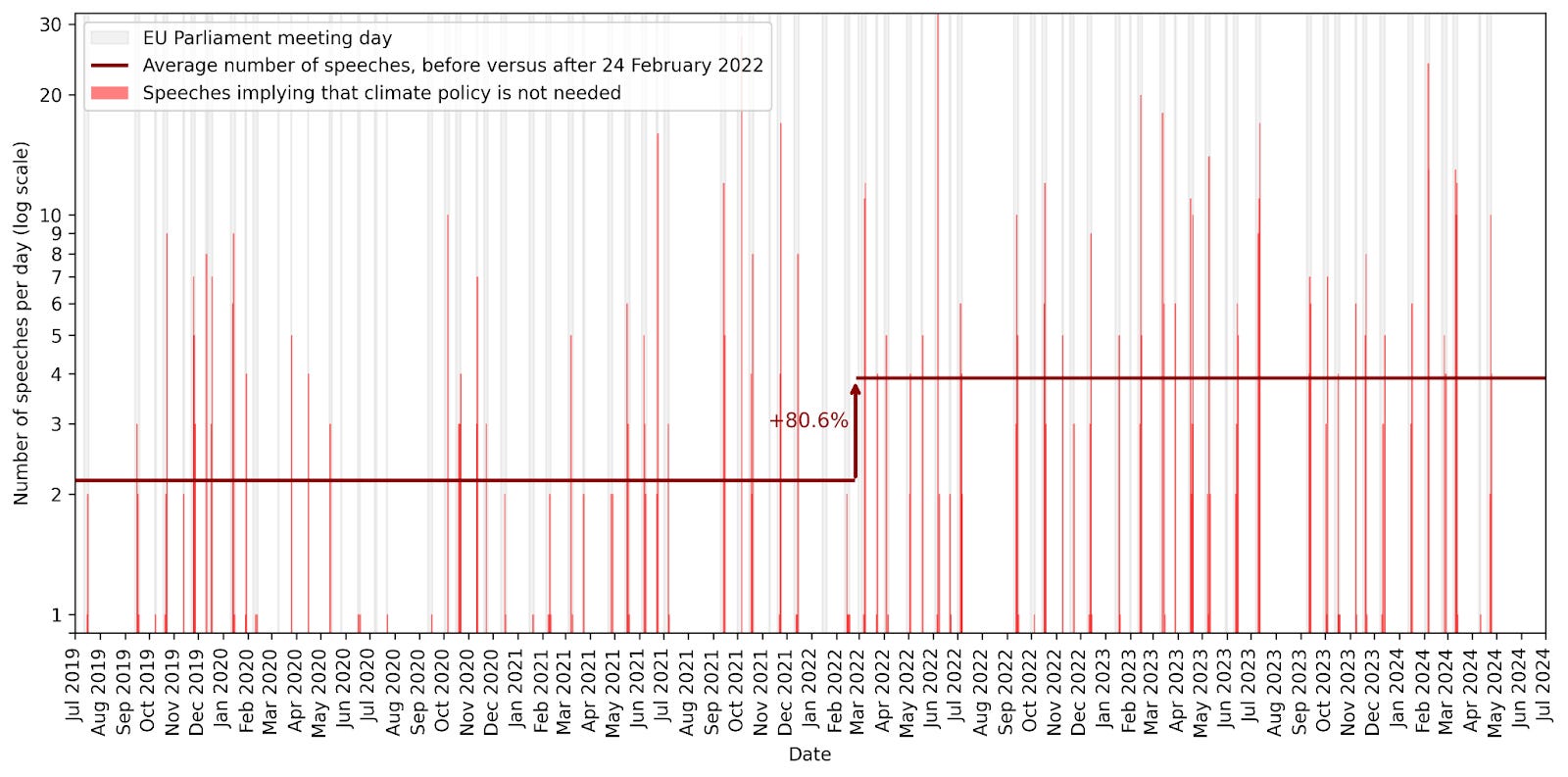
Politicians respond strategically to voters’ ‘rational irrationality’ of not wanting to be confronted with trade-offs. With increased gas prices, being in support of potential additional costs of climate policy becomes less appealing. Knowing this, politicians who generally support climate policy become more silent, and opponents increasingly question whether climate policy is needed at all.
The bigger picture
Narrative entanglement and the narrative accelerator matter for climate policy, since economic shocks spill over into the stated environmental benefits of addressing climate change. But this mechanism is not specific to climate policy. Trade-offs are also dead in the debate about immigration and free trade.
There are a number of risks of ‘politics without trade-offs’. The most obvious one is that it makes untruths part of the winning argument, thus undermining the overall coalition when parts of it turn out to be false. It is hard to sustain the story that climate action brings wealth in the face of economic hardship. But because politicians bundled the economic gain with the environmental goal, both now face doubt. When the economic argument falls, it drags the environmental argument down with it.
Something like this is happening also with immigration, where supporters of the true economic and human benefits of people moving countries are being dragged down by their unwillingness to acknowledge obvious social frictions. When you sell a difficult transition as a free lunch, support collapses the moment the bill arrives.
If we want durable policies on tricky areas such as climate, trade, or migration, we need politics that rewards those politicians willing to say: “This will cost you money. It will be hard. But here is why we must do it anyway.” Being straightforward about trade-offs could be the reason Javier Milei’s support in Argentina has not collapsed in spite of the austerity he imposed. Regardless of your view of the man (not my point here), no Argentinian can say he has not warned them.
Until trade-offs make it back into politics, our policies will be as volatile as the narratives we tell to sell them.
References:
Brzezinski, Adam and Luis Garicano. “Narrative Entanglement in Climate Policy.” CEPR Discussion Paper DP 20829, November 2025. Link to latest version.
Caplan, Bryan. The myth of the rational voter: why democracies choose bad policies-new edition. Princeton University Press, 2008.
Full quote from Johnson’s speech: “For years, going green was inextricably bound up with a sense that we have to sacrifice the things we love. But this strategy shows how we can build back greener, without so much as a hair shirt in sight. In 2050, we will still be driving cars, flying planes and heating our homes, but our cars will be electric gliding silently around our cities, our planes will be zero emission allowing us to fly guilt-free, and our homes will be heated by cheap reliable power drawn from the winds of the North Sea. And everywhere you look, in every part of our United Kingdom, there will be jobs. Good jobs, green jobs, well-paid jobs, levelling up our country while squashing down our carbon emissions.”
When the price of natural gas increases it makes the cost of climate action cheaper. So a more pessimistic assessment of the cost of climate action during a gas crisis is all the more surprising. Or am I missing something?
"My policy on cake is pro having it and pro eating it".
Boris Johnson