

Last summer I went hiking in Grand Teton National Park. The park is stunningly beautiful (seeing the mountains rise suddenly over Jenny Lake is unforgettable) and home to a wonderful, intact ecosystem, including grizzly bears, moose, many types of deer and all sorts of birds.
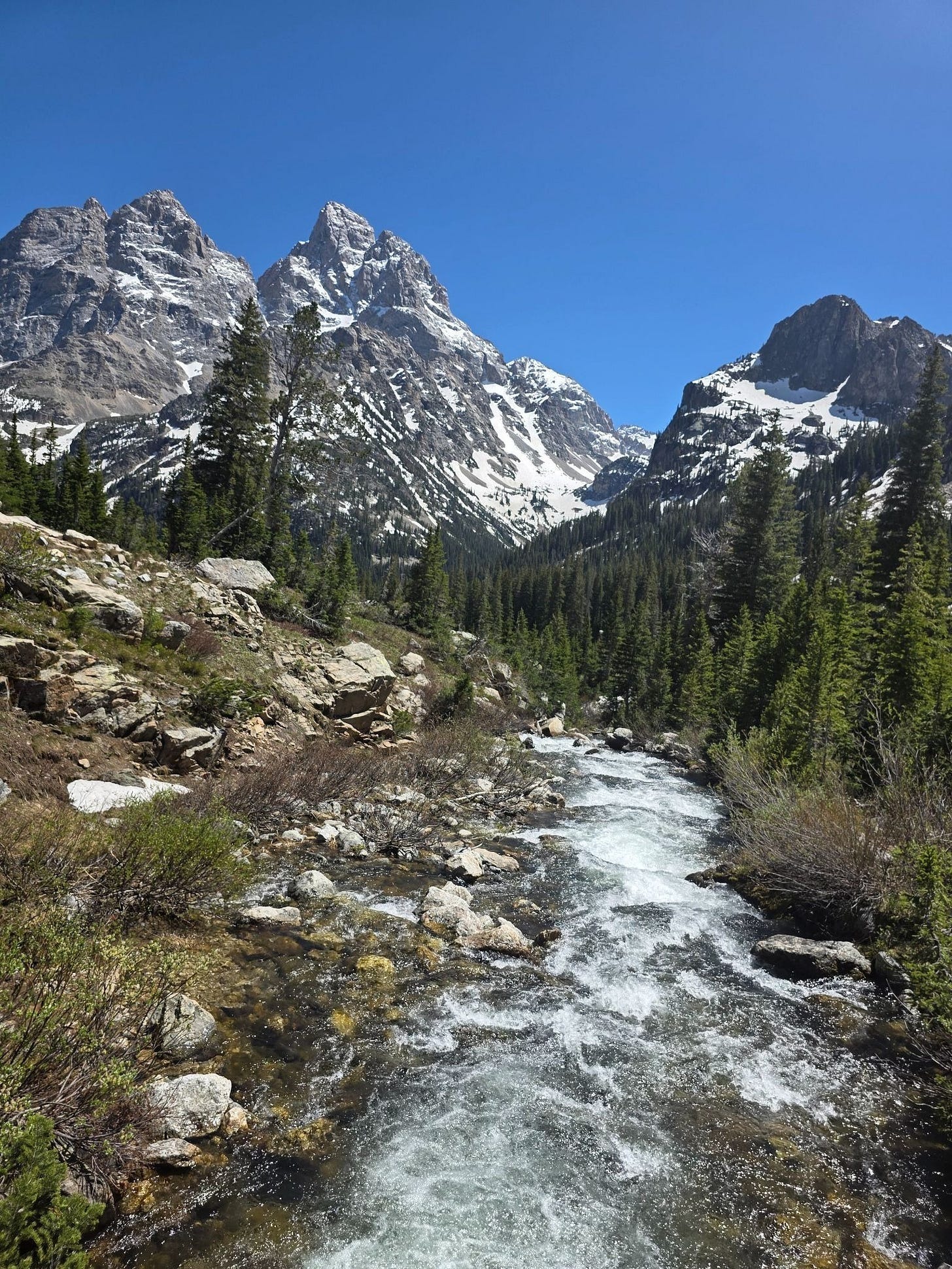
We owe the park’s expansion to John D. Rockefeller Jr., who, in horror at the gas stations and saloons growing all over Jackson Hole, decided to start buying land secretly and, against the complaints of the ranchers, managed to get Franklin Roosevelt to turn it into a national monument in 1943.
My impression is that the Grand Teton NP is what most people picture when they think about “nature preservation”: a magnificent landscape where development is forbidden, restored and managed so that its species thrive. There is nature, which is fully protected, and there is the rest, where we apply generous minimum standards to ensure clean air and clean water.
This is not the environmentalism we have today in Europe. We have a system that invests enormous sums of society’s limited time and resources protecting the species that happen to live near development: frogs that live in residential neighbourhoods; birds that live in container terminals; and bats that live on highways.
These principles are enshrined in an interlocking network of environmental rules passed by the Europe Union since the 1970s: the Birds Directive; the Habitats Directive; and the Environmental Impact Assessment Directive. Together, the Birds and Habitats directives created roughly 27,000 protected sites covering more than 18 percent of the EU’s land area. Protected sites include ponds in railway yards, an attic in a church, a sand dune under a highway, an iron mine, sixty percent of all Bundeswehr training grounds, and the outskirts of Cologne airport. Grand Teton these are not.
The Habitats Directive, passed in 1992, does not contain a general cost-benefit test. Berlin officials who delay a project to build 2,000 homes because of a few hundred toads are not able to compare the welfare of toads against that of thousands of potential residents. Instead, as the EU Court of Justice established in a case concerning the Waddenzee in 2004, projects that affect protected sites require establishing that “no reasonable scientific doubt remains” that the integrity of the site will not be harmed. The developer must prove a negative, which is why these assessments take thousands of pages.
Protection extends beyond these protected areas. The Commission 2020 assessment covered 1,389 non-bird species besides some 460 wild birds. Most consequentially, for certain species, the directive protects individual animals no matter where they are, whether the site is protected or not, as the Birds Directive does for every wild bird. The list is European, so a species that is endangered in Sweden but abundant in Spain enjoys maximal protections everywhere, including in Spain.
What makes a species?
These problems all arise when taking the lists at face value. But it’s not clear we should even do that. Some scientists argue that many species are endangered only because of how biologists are redrawing the boundaries around a species: splitting one type of bat into several narrowly distributed ones does not create any new animals, but it necessarily creates species with smaller populations and range.
This affects European legislation in the way you would imagine. The 2017 Habitats directive reporting guidance that maps old species into new ones turns 88 entries into 337 species. For example, the ‘Cobitis Toenia’ — a type of fish listed in Annex II for site protection — goes from 1 species described in the directive to 22 . While the overall Cobitis is plentiful and is always classified as Least Concern, once split into 22, some of the new species are classified as Endangered.
I am not a biologist; I do not have strong views on whether each species on the list is worth protecting. But it is notable how relatively arbitrary — and entirely unnoticed — technocratic decisions can impose immense costs on Europe’s ability to build.
Since the legislation does not allow for the weighing of costs against benefits, absurdities abound. Many critical European infrastructure and housing projects are blocked or slowed by the presence of only a few listed animals, the proximity of a habitat, or simply procedural requirements: Courts annulled Los Carriles, an 8,600-unit development in Madrid, the region with the largest housing shortfall in Spain, because a landscaping hill made from the site’s own surplus earth had skipped environmental assessment, and ecologists sued again this spring after the town approved a replacement plan in November 2025 What these examples have in common is that the same nature that the law intends to protect could be protected far more cheaply elsewhere. This summer, Spain’s government stopped the development of a 347 MW solar plant near existing gas infrastructure in the province of Toledo, because it found one active imperial eagle nest ten meters away from the planned structures. There are cheaper ways to protect imperial eagles elsewhere. Here is one: power lines cause more than half of the imperial eagle deaths recorded in Andalusia since 2000, and making a dangerous pylon safe costs about €400. Between 1992 and 2009 Andalusia fixed 6,560 of them for €2.6 million; its eagle population multiplied by two in those years reaching 60 pairs in 2009, 176 in 2025. The province of Toledo alone had 212 of Iberia’s 841 pairs, and the plant would have affected three. A levy of 0.1 percent on a plant of this size, about €200,000 at average construction costs, would have made another 500 pylons safe.
Of course if the biodiversity loss is caused by farming, then it is usually ignored. Agriculture occupies almost 40 percent of total EU land, and is the main cause of the decline of Europe’s habitats, according to the European Environment Agency. Construction is marginal by comparison. The law puts enormous posts on individual construction projects, while failing to act on agriculture, the main pressure.
The Origins of Species
Why do these policies exist? Why do we vote for policies that stop housing and energy from being built in order to save a hundred toads or bats?
It is hard to believe the majority of the public would like to spend 700 million pounds to protect one salmon’s life every 12 ( years at a British nuclear plant. I suspect that man who care about the environment care about it in a Grand Teton way: we want extraordinary natural beauty and clean air, but the laws that express those beliefs were hijacked by anti-development activists and interest groups, who gain from assessing more environmental applications and designing elaborate on-site mitigation.
These laws are supported by people who dislike development near them. For them, environmentalism is a pretext: the point is not the toads but the development itself, which they can stop by using environmental processes. It does not seem like a coincidence that environmentalism swept Europe in the early 1970s, when cities were taken over by cars and neighborhoods flattened to make way for brutalism. Understandable: anyone should want to stop that ugliness from spreading.
Whatever the reason, this “degrowth” mentality means that, paradoxically, the biggest enemy of the fight against climate change and for clean energy (solar, wind, batteries) as well as of efforts to solve the pressing housing supply problems, is this process-oriented, nimby environmentalism. An economist friend who works on stopping climate change was recently describing to me her fruitless efforts to persuade Catalan environmentalists to allow for solar, wind, transmission, and battery investment. “Everything is blocked by the greens,” she said.
The process was built by people who love nature, but employs an army of others who may or may not care, but live from it. The costs, the homes not built and the transmission lines not laid down, fall on everyone, but no one pays a large share of the excess cost since it is diffused.
I imagine many Europeans belong to “degrowth” groups. But I suspect that many more Europeans like natural beauty and want more of it, but understand that we cannot maximize it in every place and at the expense of every other value. For those among us who believe passionately in the public good that is a thriving, beautiful and abundant natural environment, we can do better.
In this blog, we advocate recognizing trade-offs and accepting there is no free lunch. But reforming these misguided policies is as close to one as it gets.
The solution, you will not be surprised to learn, goes through trade and compensation. Building new habitats cannot be financed through a law that stops construction. But it can be done through a law that facilitates development in exchange for compensation. This means moving from endless environmental assessments and litigation, to payments linked to results.
A system like this is partially in place in the United Kingdom. Since 2018, English developers whose projects would disturb great crested newts, a species under the highest level of protection, have contributed to a system of district licenses instead of making their own impact studies and building their own mitigation within their own development. The money finances conservation projects that create at least four ponds for each pond destroyed by development, in places determined by population models, and monitored for 25 years. In the five years to March 2026 the license system had financed more than 4,800 ponds and enabled 70,000 new homes. Developers reduce uncertainty and costs, while nature benefits: two-thirds of mature ponds already hold newts. A process like this has also been in effect in the US for the last 40 years: since 1982 an American developer can obtain a permit by paying for a habitat elsewhere.
Will Europe be able to build again?
Last December, the Commission proposed a regulation trying to reduce the delays in the assessments required by these directives as part of its “environmental omnibus”. The member states agreed their position on 30 September, and the Parliament is expected to vote it on November 23rd. This regulation keeps the current process, but tries to shorten it and make it a bit more rational. It allows a project to take proportionate steps to avoid harm, and allows authorities to judge the effect on the population as a whole, not on each animal. But the proposed changes still force the developer to dispel reasonable doubt and do not introduce a broad cost benefit test—it is still not possible to approve the 2000 homes by weighting costs and benefits against a few hundred toads.
A bipartisan bill just proposed in the US shows the way to a better reform of the procedures: its basic change is to eliminate the excessive procedural emphasis. If passed, an error in an environmental review will no longer halt the project or cancel its permit; those remedies can only be applied when the project breaks a substantive law on air or water. Environmental challenges are only reviewed once, skipping lower courts, and the permits, once granted, cannot be revoked except in the presence of new information that shows urgent harm. Under such a rule housing in Los Carriles would continue being built, because a court could have ordered the missing assessment done while the builders worked.
Rockefeller did not mitigate Jackson Hole. He bought it, restored it, found a way to finance it and gave it to the nation. The conservation law in Europe turns money into paperwork and process. We need to move to a world where the proof of biodiversity is how many species we expand and protect, how many future Grand Tetons we create, not how much paperwork we generate and how many projects we block.
Luis,
I think you paint too generic a picture as the birds and habitats directives being anti-developmental and degrowth.
First, a generic point. National implementation/goldplating is a far bigger issue than the directives themselves, which in my view are based on pretty solid principles. Robert Habeck changed a few paragraphs in the German implementations of both laws and the result has been an explosion of approvals followed by construction of wind farms and grids. If only other member states would take a few cues.
Second, a case study. I was part of the effort in getting Tesla's Gigafactory Berlin Brandenburg permitted and built in two years. The land was a potential home to protected bats, snakes and lizards, which normally requires a breeding season of assessments. We didn't have that time obviously so we went for an unprecedented approach to compensation: let ecologists determine the theoretical maximum of animals on the plot and compensate for that. The judge was fine also because we were super transparent and proactive about it throughout. And it was lots of fun actually, for instance we dug up an old soviet times bunker in the woods and inserted a small entrance turning it into a bat hotel that was very popular from the get go. No idea how these animals figured it this is for them ! Isn't that fascinating.
There's not so much wrong with the EU framework but rather with inflexible national implementations and minimalist, no risk corporate attitudes.
Thank you, Luis, for an excellent comment that helps re-orienting the ongoing debate within the nature-diversity community. It also fares well with the 30/30 rule approved during the COP Montreal meeting. 30 % of sea and land areas should be protected areas, whereas the rest is not.