

To pay individuals like $100 million over a four‑year package, that’s actually pretty cheap compared to the value created for the business. Benjamin Mann, Anthropic Cofounder
Do we need armies of business analysts creating PowerPoints? No, the technology could do that. Kate Smaje, Head of technology and AI, McKinsey and Co.
While Meta and Google bid against each other for senior AI talent, with packages reaching $100 million, AI is also eliminating entry-level positions at those firms. Paraphrasing McKinsey head of tech’s statement to Bloomberg above, what is the point of hiring junior analysts?
This creates what I’ll call here the 'AI-Becker problem'. Gary Becker argued that if companies must pay for training, they will underinvest in general training because rivals can poach the trained worker. In the AI-Becker problem, companies underinvest in general training because junior employees don’t create enough value to solve the traditional problem.
The traditional economics of professional training
Professional services (and other fields) operate as knowledge-based hierarchies, as I have studied in work with Thomas Hubbard on law firms. Consider Goldman Sachs in 2019: 38,000 employees arranged in a pyramid with thousands of analysts, a smaller cohort of associates, and a smaller group of managing directors. Each level learns by doing routine work for the level above.
This pyramid serves two economic purposes. First, it allows firms to leverage senior talent efficiently, since one partner can supervise ten associates, multiplying the impact of their expertise. Second, it creates a training ladder for juniors, in which juniors subsidize their own learning.
The training economics solves what Gary Becker identified as the fundamental problem of human capital investment. In Becker's analysis, firms won't pay to train workers in general skills (the kind of skills that are useful in any firm) because rivals could poach employees after they're trained. Why would Goldman invest millions in training analysts if JPMorgan could later hire them with their newly acquired expertise?
Employers solve this ‘Becker poaching problem’ by ensuring entry-level roles so that juniors generate revenue as they learn. The associate accepts lower wages in return for training, while the firm captures immediate value from their work. This is what Luis Rayo and I have termed ‘relational knowledge transfers’.
This arrangement works because junior tasks create economic value. Apprenticeships are long and low-paid because the teacher is receiving rents from the junior in exchange for transferring just enough knowledge to keep the junior in the firm.1 The novice's routine work subsidizes their own training.
How AI destroys training model
If AI eliminates the junior work that once subsidized learning, it will devalue the currency workers have traditionally used to pay for their training. Advances in generative AI mean many routine tasks can now be done better by machines, and it is precisely the routine work that juniors historically did to pay for their training.
The legal industry will be one of the first to show this transformation. Law firms can already use OpenAI’s o3 model to automate contract drafting and due diligence. Allen & Overy’s innovation head noted it would be “a serious competitive disadvantage” for firms not to adopt such AI. These tools review documents in minutes instead of weeks, compressing junior-level work.
In consulting and finance, Deep Research tools can handle routine tasks that used to keep teams of junior analysts busy for days. McKinsey has introduced its own AI tool, “Lilli”, which answers half a million queries per month, supposedly saving consultants 30% of time on research tasks. The tool can also do the infamous PowerPoints that once occupied armies of young consultants.
The anecdotal data here is pretty strong; this, from a recent article by New York Times tech columnist Kevin Roose, is not unusual:
One tech executive recently told me his company had stopped hiring anything below an L5 software engineer — a midlevel title typically given to programmers with three to seven years of experience — because lower-level tasks could now be done by A.I. coding tools. Another told me that his start-up now employed a single data scientist to do the kinds of tasks that required a team of 75 people at his previous company.
Evidence of the breakdown
The breakdown of traditional training pathways is already visible in hiring data, although I am not aware of any careful work attributing causality to Artificial Intelligence.
New York Fed data show that the unemployment rate among recent college graduates has risen by 30 percent since the pandemic, compared with an 18 percent increase among all workers. While multiple factors contribute, most notably a correction of the excessive hiring during the pandemic years, AI appears to be a contributor.
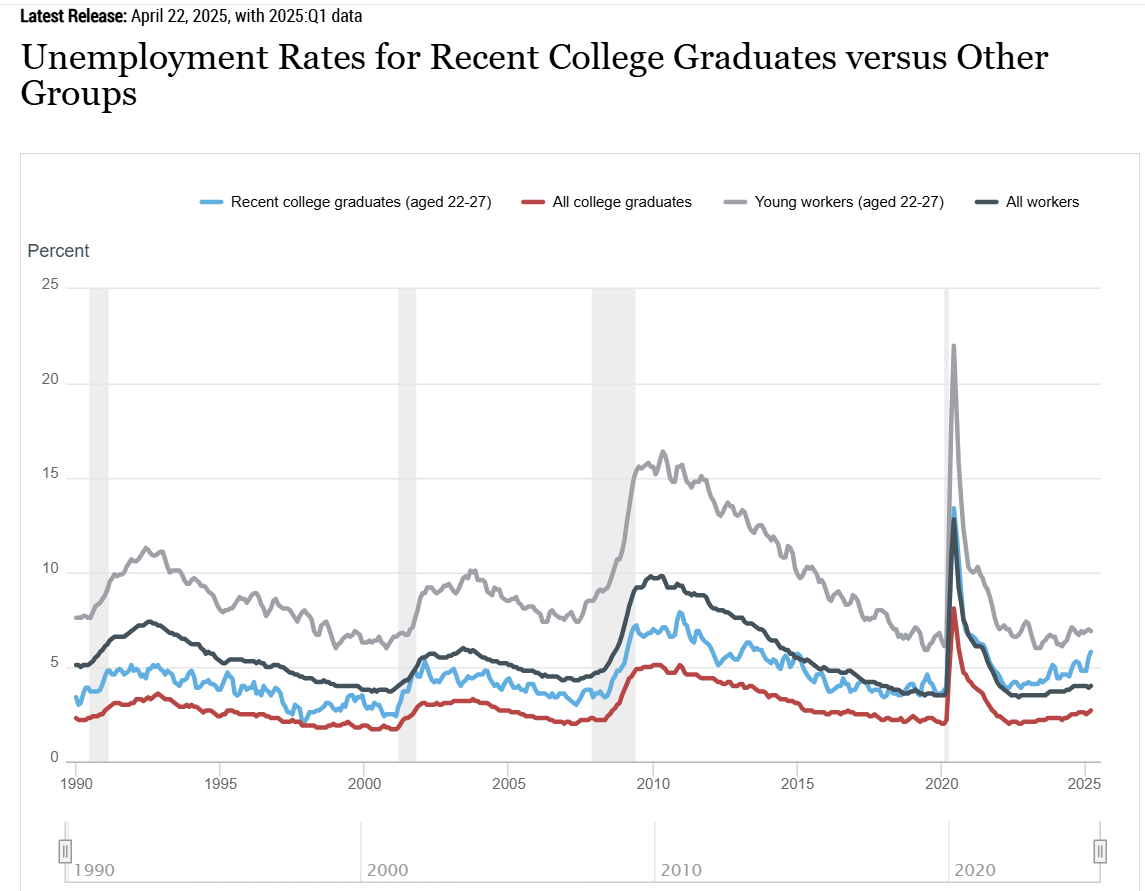
Source: NY Fed
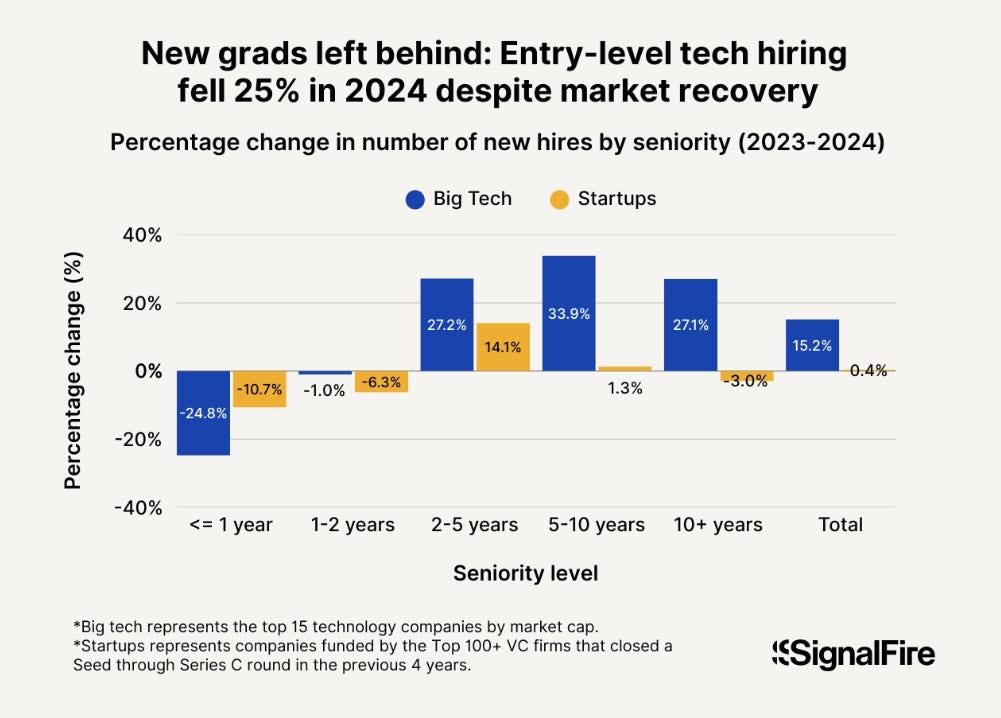
Source: Signal Fire
The Autonomy Threshold
This transformation creates what I have called in ongoing work with Jin Li and Yanhui Wu from HKU the “autonomy threshold”.2 Below the threshold are the tasks that AI can execute autonomously, such as drafting standard NDAs and employment contracts or cleaning data. Workers whose skill levels fall below that threshold compete with AI.
Above the threshold are the tasks hard to automate, requiring judgment or relationships. Those whose skill is above the threshold can use AI as a tool.
This explains the two different and opposing trends illustrated by the quotations that open this post. Thanks to AI, a single senior professional can oversee far more output than before. But the associates and analysts who performed this work while learning become irrelevant. This causes the economic foundation of apprenticeship to collapse.
New Ladders
How can we preserve the first rungs of the ladder and keep training alive? First, governments can subsidize it. Singapore’s SkillsFuture scheme refunds up to 90 percent of wage cost when firms deliver certified training.
Second, the private sector could develop similar solutions through industry-wide training consortiums where competitors share costs and benefits of developing talent, or public-private partnerships that fund compressed apprenticeship programs in exchange for commitments to domestic employment.
Third, universities must adapt. When they enter firms, students must already be capable of performing work above the level that AI can replace. This means we at educational institutions must develop curricula able to train students to a higher level of training than before, above the autonomy threshold. Students must be able to understand AI capabilities and limitations, and acquire experience working with AI as a tool while learning to make the judgment calls that remain uniquely human. Curriculum must centre on the meta‑cognition that lives above the supervision threshold.
The challenge ahead is making sure today’s entry-level workers actually get the experience needed to become tomorrow’s experts, in spite of AI taking over training grounds, and in spite of firms not having the incentives to provide it.
References
Garicano, Luis. “Hierarchies and the Organization of Knowledge in Production.” Journal of Political Economy 108, no. 5 (2000): 874-904.
Garicano, Luis, and Thomas N. Hubbard. “The returns to knowledge hierarchies.” The Journal of Law, Economics, and Organization 32, no. 4 (2016): 653-684.
Garicano, Luis, and Luis Rayo. “Relational knowledge transfers.” American Economic Review 107, no. 9 (2017): 2695-2730.
Garicano, Luis, and Esteban Rossi-Hansberg. “Organization and inequality in a knowledge economy.” The Quarterly journal of economics 121, no. 4 (2006): 1383-1435.
Garicano, Luis, and Esteban Rossi-Hansberg. "Knowledge-based hierarchies: Using organizations to understand the economy." Annual Review of Economics 7, no. 1 (2015): 1-30.
See our analysis of this mechanism in the AER 2017 paper with Luis Rayo “Relational Knowledge Transfers”, cited above.
Originally in this essay the “supervision threshold”, updated to “autonomy threshold” to echo the language in our book “Messy Jobs”.
AI is also changing the value of training itself. Fundamentally, some skills can be trained and some cannot. When a skill can be clearly defined and clearly evaluated, it’s much easier to train that skill. But this is also the sort of skill that AI is the best at replacing.
If the AI can get an A in a class, what useful skill is a human learning when they get an A in that class? For some classes, the answer will be “nothing”. That skill just won’t have value any more. Like learning to use a card catalog to find books.
A very interesting article. Regarding university: is the current European framework (four years of undergraduate studies plus a master's degree) sufficient, or will this challenge require longer educational careers? In short, are the professional and educational cycles being stretched at the same time as the biological one?