


Paul Krugman wrote two posts this week arguing that Europe is broadly not falling behind the United States. He argues that the change measured by the Draghi report is mostly due to growth in the technology industry, which has distorted GDP numbers without actually leading to higher standards of living in the United States. We should believe our eyes when we walk around France and walk around Mississippi.
Unfortunately, Krugman is wrong. The measures he uses understate European stagnation.
This matters enormously. Divergence with the United States is the strongest evidence for reform in Europe. The opponents of change justify the current course by arguing that Europe is either at the frontier — as rich as anyone else — or that it can’t be any richer without intolerable trade-offs: Americans may be wealthier but this is due to worse public services or greater inequality.
This is not true. Something America is doing is making it broadly richer than Europe. In this post, we’ll answer the following questions:
What’s going on with the growth numbers?
Is it all technology?
What about inequality?
What about hours worked?
Is America not a bad place to live?
1. What’s going on with the growth numbers?
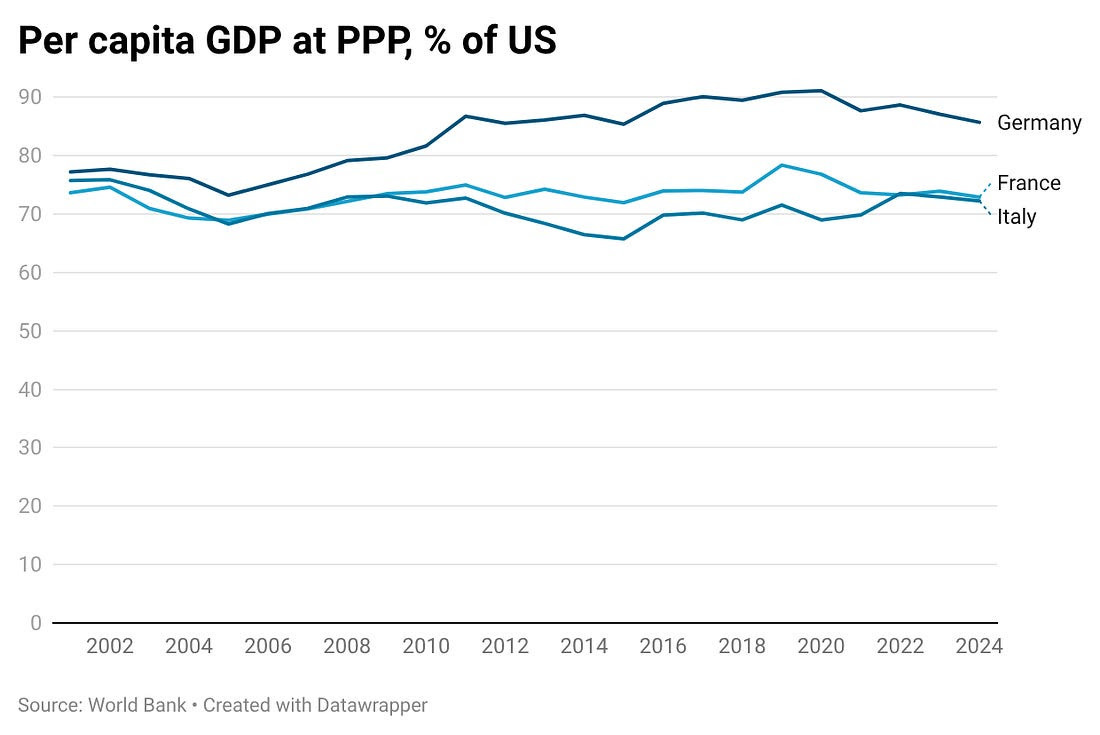
Krugman bases his analysis on the comparison of the United States, France, and Germany at purchasing power parity in current prices. If we use this metric, France’s and Germany’s position relative to America has been roughly constant since 2000.
But current price comparisons miss productivity gains in sectors where prices fall. Imagine America produces twice as much software, while the price of each unit of software halves. At current prices, the value of American software output looks unchanged even though the volume of software produced has doubled.
For comparisons of growth over time, most economists commonly use constant prices: they fix the base-year PPP price level and apply each country’s own real output growth on top of it. In the previous example, you would use the relative prices from 2000 to measure both 2000 and 2024 output and correctly identify that American output of software has doubled.
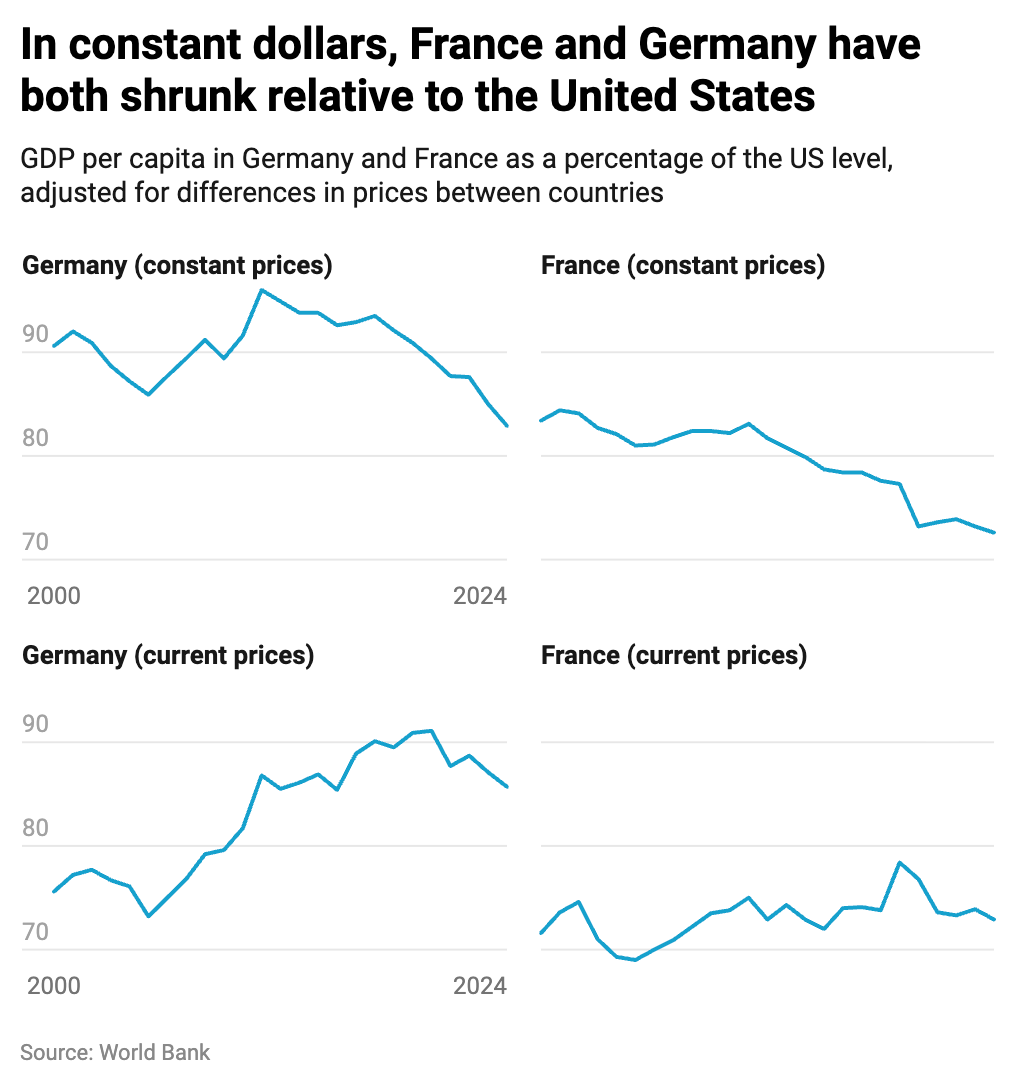
American output growth has concentrated in tech, where prices have fallen tremendously as productivity rises. This does not mean current price PPP is useless. Current prices and constant prices answer different questions; the second is a better measurement of real growth over time. In terms of the volume of things produced, America has pulled away from Europe.
2. Is it all the tech industry?
Krugman recognizes this divergence in his post, but notes that most of the real output growth is due to increasing productivity in computers and the internet. This constant-price divergence, he argues, is real but not welfare-relevant. The American growth lead is an accounting artefact of measuring more iPhones at base-year prices, not a sign that Americans are actually richer, because Europeans buy the same iPhones at the same world prices as Americans.
But this is not the right way to think about the world today, as an earlier Paul Krugman would have argued.
To make the welfare argument precise, Krugman asks us to consider a world where we have two countries that make two tradable products — say cars and software, workers are the same and can make both goods, and consumers spend fixed shares of their income on each. Car manufacturing productivity is the same on both sides of the Atlantic. Software productivity grows over time, but only America makes software.
Krugman shows three results in this simple world. Cars are tradable and equally productive everywhere, so they sell at one world price, which means American and German car workers earn the same wage. But because workers are interchangeable, American software makers can always hire away car workers, so American software wages can’t rise above American car wages. American software productivity rises, but American software wages stay tied to German car wages. Meanwhile, competition between software makers ensures they earn no profits.
The result is that Americans and Europeans end up better off than before to the same extent: they earn the same wage as before, but software is cheaper, so the same wage everywhere buys more goods. Measured American GDP grows faster at constant prices because the quantity of software produced in America rises, and constant-price accounting values the extra software at base-year prices when it was still expensive. But, accounting aside, nothing real has changed in the relative position of the two countries.
This model is helpful because it helps us see why technology does in fact make America richer.
Start with the tradability assumption. The European and American economies do not exclusively produce tradable goods. Much of what households buy is non-tradable: housing, healthcare, childcare, restaurants, education, and almost every local service.
Once a good is non-tradable, the wage is not set globally but in local markets. Newly productive American technology companies bid workers away from haircutting and waiting tables to write code. Since Americans still need haircuts and cannot import them, the wages of hairdressers increase, without it affecting wages for hairdressers in Germany. American software wages rise and so do American non-software wages. In Europe this does not happen, because there is no growing software sector to start with.
Another problem is that software, and technology more broadly, is not priced at marginal cost. In Krugman’s simple model competition pushes prices down one-for-one with productivity growth. But Apple’s margins are around 40 percent and Anthropic’s inference margins are at 70 percent. The major platforms enjoy network effects, switching costs, and lock-in that hold prices well above what a competitive market would deliver. A large share of the productivity gains in technology stays as profit. European consumers get less of the upside from cheaper technology than the model predicts.
Apple, Microsoft, Nvidia, Alphabet, Meta, and Amazon together are worth $21 trillion, more than the entire combined stock market value of all European stock markets. Around 60 percent of US equity is held by American households and institutions. The European share is smaller and concentrated in wealthy countries with private pension plans (Netherlands, Switzerland and the Nordics). The median French or Spanish household holds almost no equity.
Software has led to enormous profits for American technology companies and extraordinary wages for American technology workers and their suppliers. (Try getting a haircut in San Francisco). The median employee at Meta, a company with almost 80,000 employees, earned $388,000 in 2025.
This advantage is not going to go away any time soon. In all likelihood, it will increase. Paul Krugman has a seminal 1991 paper, cited in his Nobel prize, which showed that comparative advantage in modern industries is not handed down by nature. It is produced by increasing returns to scale, specialized labor markets, supplier networks, the agglomeration of suppliers, workers, and ideas in particular places. Once an industry concentrates somewhere, the concentration is self-reinforcing.
American lawyers, accountants, doctors, marketers, and managers in technology-adjacent jobs work with better tools, sold by firms next door, supported by engineers down the street. Krugman’s 1991 paper called these forward and backward linkages: the cluster lowers the cost and raises the quality of inputs for every nearby producer, and the productivity spillover propagates outward from the centre.
If American leadership in technology is the product of agglomeration in Silicon Valley, Seattle, and Austin, then Europe is not merely consuming the same iPhones at the same price as Americans. Europe is being pushed away from the next round of technology industries, because those industries will emerge in existing clusters. This, in turn, will show up as higher wages for American technology workers, more demand for non-tradable American goods, and more profits for American capital owners.
3. What about inequality?
Another retort is that GDP per capita numbers hide substantial inequality, and so even if America is rich on average, this is mostly due to the super wealthy. There is a trade-off: the Europeans are giving up average wealth in the form of rich elites to make sure that the median person has a good life.
But this American inequality, at least as it’s commonly understood in Europe, is something of a distraction. Krugman fairly says that he won’t put exact numbers to the phenomenon:
My colleagues at the Stone Center on Socio-Economic Inequality, who are experts on the topic of income inequality, are not convinced by some widely cited analyses of this issue. So for now, I will simply assert that the role of income inequality in underestimating the performance of Europe versus the US is an important component, but one to which I can’t put exact numbers.
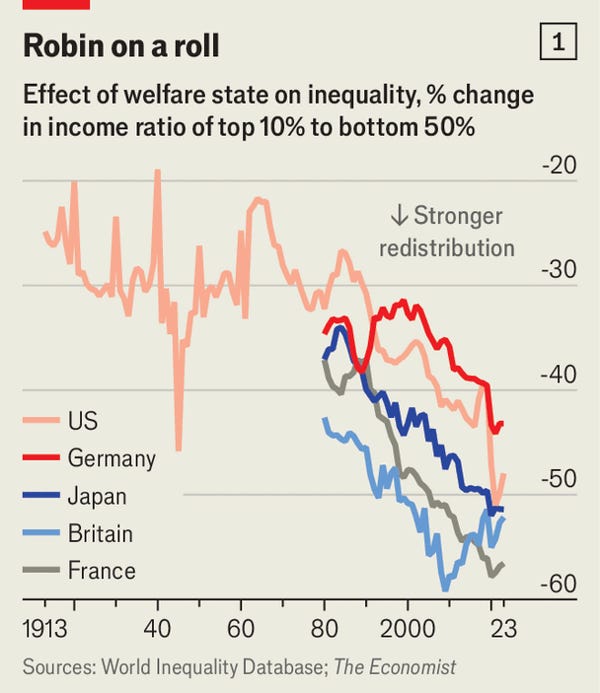
The best answers show that, despite the US’s high pre-tax income inequality, it also achieves higher median incomes than Europe, in part because of such a high base, and in part because it actually redistributes more than many European countries.
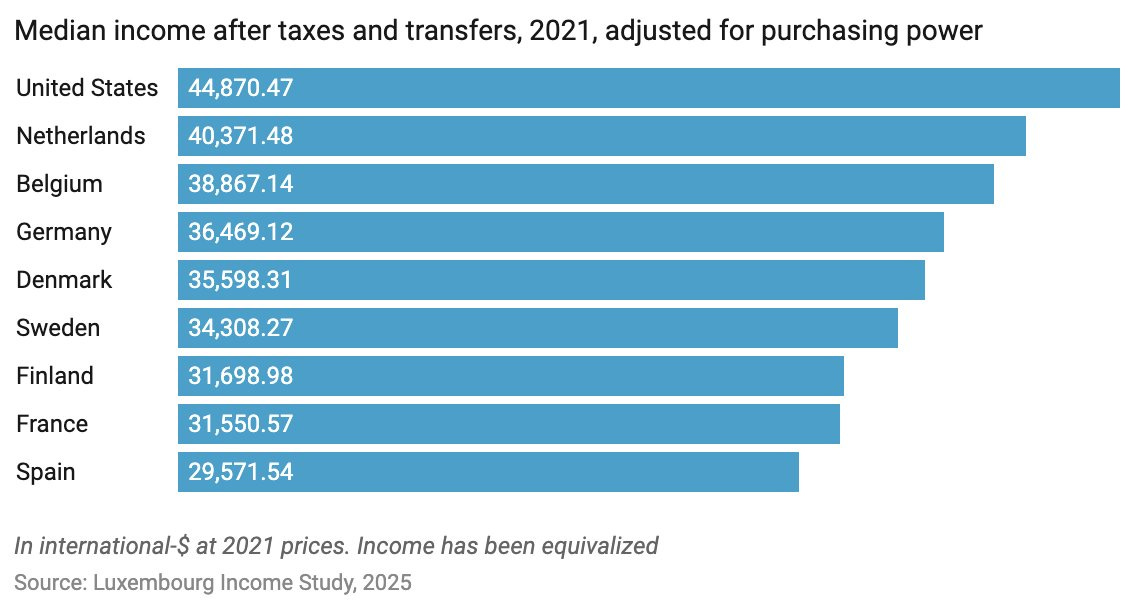
The cleanest comparison that adjusts for this is median equivalised disposable household income: income after cash taxes and transfers, adjusted for household size and purchasing power. According to the OECD’s 2021 numbers, the median American earns 30 percent more than the median Dutchman, about 31 percent more than the median German, and about 52 percent more than the median Frenchman.
Below is a chart from the Luxembourg Income Study that shows a similar but slightly smaller effect. Note that in both cases these numbers are from 2021, while the fastest divergence between the United States and Northern Europe has been during the last five years: ECB analysis finds labour productivity per hour rose 6.7 percent in the US from Q4 2019 to Q2 2024, versus 0.9 percent in the EU.
4. What about hours worked?
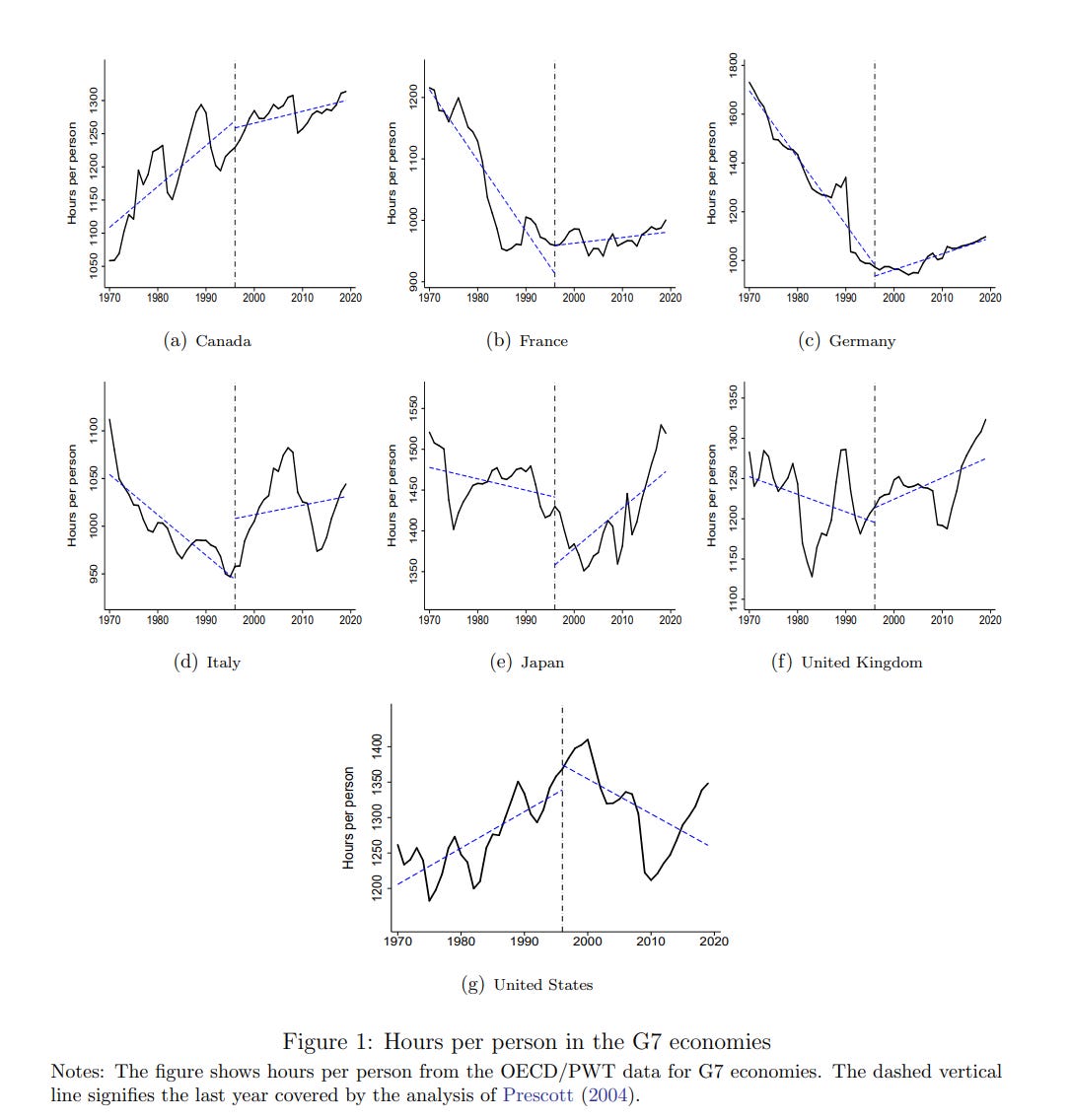
Krugman points out that while American GDP per person is higher, most of this is because Americans work more. Once you adjust output for hours worked, the gap shrinks to single digit percentage points. Europeans have chosen leisure over income: they are as productive per hour and take their gains in August holidays and shorter weeks.
But American GDP has pulled away from European GDP at constant prices since 2000, especially in the last six years. As Jesus Fernandez-Villaverde has pointed out, for this divergence to be an hours worked story, Americans must work more relative to Europeans now than they were in 2000.
The opposite has happened. Birinci, Karabarbounis, and See in a 2026 NBER paper show that about half of the American-European hours gap that existed in the 1990s has reversed by the end of the 2010s. Americans work fewer hours per person than they did in 2000, while most Europeans work more hours per person. This is mostly because more Europeans now work at all, and fewer Americans do. (In the authors’ view, the American decline is driven mainly by the expansion of government health benefits for the non-employed, especially Medicaid, which raised the value of not working. The European rise reflects a mix of higher wages, more pleasant jobs, and, in some countries, lower benefits.)
5. Is America not a bad place to live?
Perhaps the reason why Krugman’s post did so well, and the reason why many find the divergence hard to believe, is what Krugman calls the “walking around test”. Walk around Alabama and France: surely the former cannot be substantially richer than the latter?
There are a number of things going on here. The first is where wealth is concentrated. American cities often have poorer centres and richer suburbs or exurbs; European cities often preserve richer and more attractive historic cores. A tourist visiting an American city versus a French one will see very different segments of the income distribution.

Americans in Europe are self-selecting and go to the nicest and richest European cities. Meanwhile, Americans have disproportionately neglected their most important cities, like San Francisco and New York. The places Americans show visitors are often not where American private consumption is concentrated.
Rather than a walking around test, do a driving around test. Go to the periphery of any modern American city and see a level of new-built material wealth that is extremely uncommon in Europe, with thousands of enormous (and, sure enough, ugly) four- or five-bedroom homes. In the South, in places like Nashville and Austin, drive around the downtowns to see hundreds of luxury apartment buildings springing from the ground. This construction boom is a signs of enormous prosperity, which is replicated virtually nowhere in Europe today.

To be clear, much of this urbanism is terrible, and many Europeans and Americans rightly hate it. But the idea that Alabama cannot possibly be rich because the downtowns look bad is wrong.

The other question is generational. Contrary to what both Europeans and Americans commonly believe, housing often costs more in Europe than in the United States, despite the quality of the housing stock (especially size) in the latter generally being much better. Europe has nice city cores but these are inaccessible to young Europeans. The young Europeans we know in London or Amsterdam rarely live in a neighborhood an American would recognize.
Consider the salaries available to entry-level workers. As Matt Yglesias has pointed out, the starting pay for a London police officer is $57,000, while the starting pay for a police officer in Washington, DC is $75,000. The entry-level Deloitte consultant job in Madrid pays around €28,000, roughly $33,000 per year, according to Glassdoor. In Charlotte, the largest city in North Carolina, the entry-level Deloitte job pays $63,000.
Europe looks great to Americans because Europe is great for people with American incomes to buy the nicest it has to offer. But the nicest it has to offer is not available to (young) people in Europe today.
We are neither compulsive Americanophiles nor rabid Europhobes. There are many things to dislike about life in America. But it is a central truth about the world that, relative to 25 years ago, the gap in material wealth has shifted dramatically in America’s favor. Something that America is doing is working.
Disparities in health care and outcomes, and in mortality, are notably absent from this discussion.
I very much appreciate the focus on data and facts about Europe’s economic stagnation, rather than rhetoric about how things that are often not even relevant for the economic comparison are supposedly worse in the US, as a form of 'Eurocope'. If Europe wants to improve, we first need an honest understanding of the underlying facts and problems